
Snyk watches what developers commit. WASViking also watches what actually ships.
Snyk made open source security part of the developer workflow, and many teams started there. WASViking follows the same components past the commit: into the build, onto the hosts that run them and out to the live site, checks every SBOM against new advisories each day, keeps raw secrets inside your environment, and hands your auditor a signed record of all of it.
- Repository acme/billing-worker, pom.xml
- Host billing-worker.stg, SBOM from the Sentinel agent
- Live site legacy-portal.acme.example, detected from outside
- Build blocked in CI: exit 70, KEV-listed
Where the difference shows up in daily work.
Both products find vulnerable open source components and leaked credentials. The difference is how far past the repository they look, and what you can prove afterwards.
Past the repository
The same component inventory covers repositories, builds, the hosts that run them and the live site seen from outside. The legacy portal nobody builds any more still shows up.
Secrets stay where they are
The Sentinel agent scans on your host. Only a hash and a masked preview reach WASViking, and optional live verification tells a working key from a harmless match.
An SBOM your auditor accepts
A signed Evidence Bundle with the consolidated CycloneDX, drift, findings and audit trail, shared by token and password and revocable at any time.
No bill per developer
WASViking is licensed by plan. Developers who commit code are not counted; only the people who sign in to the console use a seat. Hiring ten engineers does not change the supply chain line on the invoice.
Developer-first tools cover the middle. Risk also lives at both ends.
Repository scans, build checks and daily monitoring are table stakes, and both products do them. WASViking adds what is running on your hosts and your live sites, and closes with evidence.
Live site
Components fingerprinted from the outside on the running application, including sites with no repository you can scan.
Repository
Manifests and lockfiles read from GitHub or Bitbucket, with a CycloneDX SBOM on every scan.
Build
The Sentinel CI step builds the SBOM and fails the pipeline on a CISA KEV match before the merge.
Daily re-check
Every live SBOM matched again each day against OSV and CISA KEV, with alerts only when something meaningful changes.
Host and evidence
SBOMs from the hosts that run the software, and a signed Evidence Bundle for auditors and customers.
Dark steps: what a developer-first SCA tool covers. WASViking covers all five in one inventory.
Half of ACME's known-exploited components were not in a repository.
Vendor appliances, legacy portals and hand-built servers carry open source too. A repository-only view never sees them.
ACME components listed in CISA KEV, by where they were found
10 known-exploited components in use
Five of the ten would not appear in a repository-only scan.
One query, every place
Ask which services run a given version and get every repository, host and site with the last time it was seen, across all SBOMs in the tenant.
Alerts that stay signal
New exposures become findings automatically. A known finding notifies again only when it lands in CISA KEV, its severity rises or a fix becomes available.
Twelve weeks of vulnerable components going away.
Once the build gate stopped new known-exploited components at the merge, the team could spend its time on the backlog instead of chasing new arrivals.
ACME open vulnerable components with a fix available
Weekly, across repositories, builds and hosts. Lower is better.
Baseline for legacy projects
Baseline mode lets an old repository pass on its known backlog and fail only on what is new, so the gate goes on without stopping every build on day one.
Exit codes a runner understands
Separate exit codes for a KEV-listed component, any other finding and a clean build, so each pipeline decides whether to fail or warn.
Illustrative data from the ACME demonstration tenant
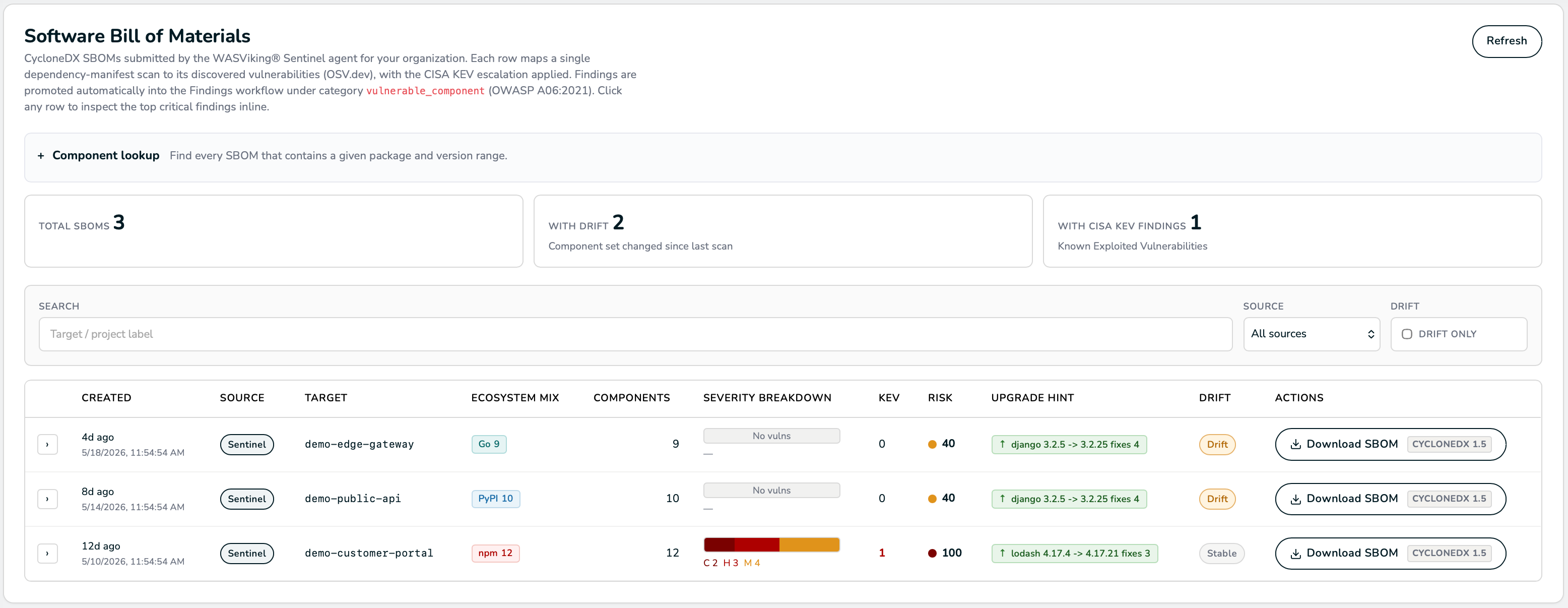
Every component, where it runs and what it exposes.
Submissions, components, known-exploited matches and drift since the previous SBOM, next to the findings they produced.
Capability by capability, what each product delivers.
The Snyk column covers Snyk Open Source, SBOM and Snyk Secrets. Where both products do the job well, we say so.
| Capability | Snyk | WASViking® |
|---|---|---|
| Open source components | ||
| Repository scanning | Projects imported from the source control integration and tested on a schedule | GitHub App or Bitbucket connection, scanned on the plan cadence and on pushes to the default branch, no pipeline change On par |
| Build gate | CLI and CI integrations that fail on a severity threshold | Sentinel CI step with separate exit codes for CISA KEV matches, other findings and clean builds, plus a baseline for legacy projects On par |
| Vulnerability data | Snyk Vulnerability Database | OSV and CISA KEV ingested every day, with every active SBOM matched again retroactively On par |
| What is running outside the repository | Manifests, lockfiles and container images | Also SBOMs from the hosts that run the software through the Sentinel agent, and components fingerprinted from the outside on live sites Goes further |
| SBOM | ||
| SBOM generation | CycloneDX and SPDX export from the CLI and the API | CycloneDX on every repository scan, every build and every host submission, kept per submission with drift On par |
| SBOM as evidence | SBOM files and reports | Signed Evidence Bundle with consolidated CycloneDX, branded cover, drift, findings and audit trail, shared by token and password and revocable Goes further |
| Secrets | ||
| Detection | Snyk Secrets, generally available since August 2026, with machine learning assisted detection | Detection in code and git history with an AI classifier that suppresses test, documentation and placeholder matches On par |
| Where the secret goes | Scanned through the Snyk platform and CLI | Scanned on your host by the Sentinel agent. Only a SHA-256 hash and a masked preview reach WASViking, with optional live verification at the provider Goes further |
| CommercialLicensing | ||
| What drives the price | Contributing developers to private repositories, per product | The WASViking plan, with supply chain visibility and threat intelligence in the platform. Developers who commit code are not counted, only console users Goes further |
What the same platform does with the same software.
A vulnerable component matters because of the application around it. WASViking tests that application and the servers it runs on.
External and internal DAST
Authenticated testing of the running application and its APIs, with our own out-of-band collaborator for blind classes.
Code Security
Static review of the code that decides access, with IDOR and broken authorization reported with the route, the parameter and the fix.
Supply-chain indicators
Add your own indicators of a compromised package, run them as a dry run first, then apply them to every SBOM in the tenant.
Point both at the same software and compare.
The evaluation runs on your own repositories, builds and servers, so the decision rests on your own results.
Connect the repositories
Install the GitHub App or approve the Bitbucket consumer, and switch on the repositories you already test.
Add one pipeline and one host
Drop the Sentinel CI step into one build and run the agent on one server that hosts a legacy application.
Search for one component
Pick a component you worry about and see every place it runs, in both tools.
Issue an Evidence Bundle
Share it with your auditor or a customer and see how the conversation changes.
Frequently asked questions
Can WASViking replace Snyk for open source and secrets?
For finding vulnerable components and leaked credentials across code, builds, servers and live sites, yes, with signed evidence on top. Snyk opens upgrade pull requests automatically; WASViking names the fixed version on each finding and routes it to Jira or ServiceNow. Teams that rely on automated upgrade pull requests should weigh that during the evaluation.
Which ecosystems are supported?
npm, yarn and pnpm, PyPI and Pipfile, Go, Composer, Maven, RubyGems and Dart, with CycloneDX output. Live sites are fingerprinted from the outside regardless of how they were built.
Do secrets ever leave our environment?
Not when the Sentinel agent scans them. The raw value stays in memory on your host only long enough to verify it, if you ask for verification, and is then discarded. WASViking receives a hash, a masked preview and the verification result.
Can we keep our current CI setup?
Yes. The Sentinel CI step is one command in GitHub Actions, Bitbucket Pipelines or any runner that reads exit codes, and it can run next to your current check during the evaluation.
How is it licensed?
By WASViking plan. Software supply chain visibility and threat intelligence are part of the platform. Plans set the number of console users, and developers who only commit code are not counted. Our team prepares a quote from your real scope.
Snyk is a trademark of Snyk Limited. WASViking LLC is not affiliated with or endorsed by Snyk Limited.
The Snyk column reflects publicly available product documentation reviewed in September 2026. Features, editions and licensing terms vary by contract and change over time, so validate each row in your own evaluation. ACME figures on this page are illustrative data from a demonstration tenant, not customer results.